If you run a trade or home improvement business, you’ve almost certainly been told you need a proper lead generation marketing funnel. Build the funnel, the theory goes, and prospects will pour in one end and paying customers will walk out the other. It sounds simple on paper. In practice, most businesses that try to build one from scratch spend months (sometimes years) getting it right, and a lot of them never do.
This isn’t a blog telling you funnels don’t work. They do, for the businesses with the budget, the data and the patience to build them properly. But for most trade and home improvement companies, a lead generation marketing funnel is a lot of overhead for something you could simply buy the outcome of instead. We’ll walk through what a funnel actually is, where it earns its keep, where it falls down, and why an increasing number of trades businesses are skipping the whole process in favour of buying appointments that are already booked and qualified.
What Is a Lead Generation Marketing Funnel?
A lead generation marketing funnel is the journey a stranger takes from first hearing about your business to becoming a paying customer. It’s called a funnel because it’s wide at the top and narrow at the bottom. Lots of people enter; only a fraction come out the other end ready to buy.
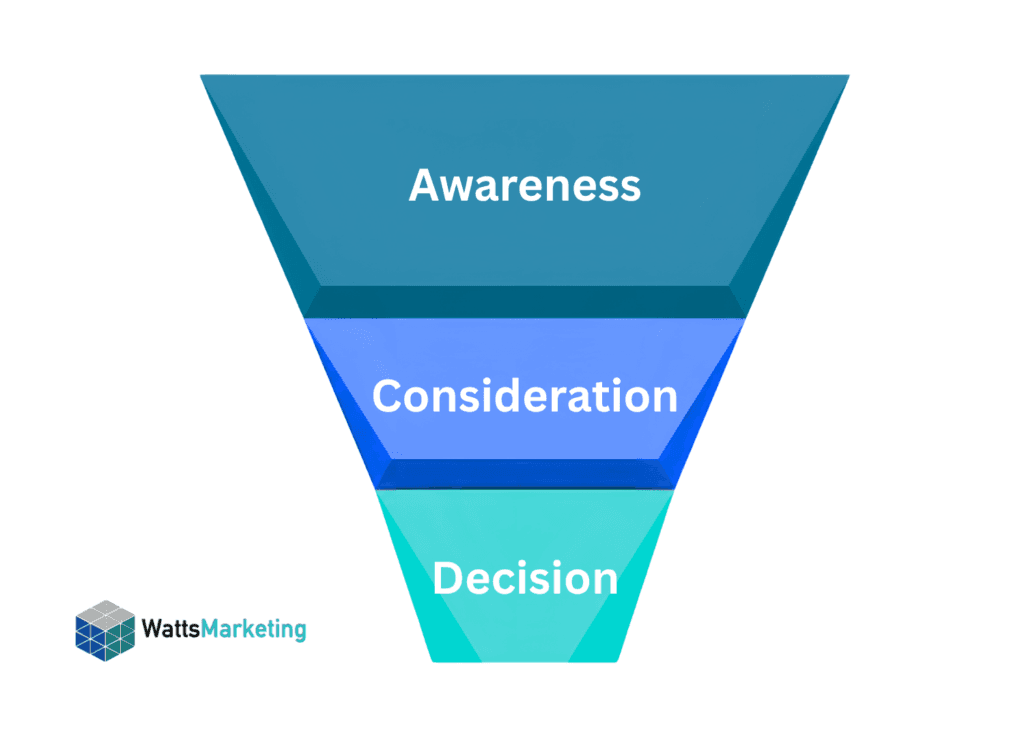
Most versions of the funnel break down into three stages: awareness, consideration and decision. At the top, someone spots a blog post, a social ad or a Google search result and realises they might have a problem worth solving. In the middle, they start comparing options, downloading guides, reading reviews and working out who to trust. At the bottom, they’re weighing up a small handful of suppliers and deciding who gets the call.
No two funnels look the same. A funnel for a contractor selling a big-ticket home installation will look completely different to one for a local trades business running local ads, because the buying decision, the price point and the trust required are all different. That’s the first problem with treating “build a funnel” as a single, repeatable task. It isn’t one. It’s a different build for every business, every audience and every offer.
Why Lead Generation Marketing Funnels Are Important
Done well, a funnel gives you a repeatable system instead of a string of one-off wins. You’re not relying on luck or a viral post to bring in work. You know roughly how many people need to see your content to get one qualified enquiry, and you can scale that up or down depending on how busy your sales team is.
A funnel also does the job of sorting the tyre-kickers from the genuinely interested before your team ever picks up the phone. Someone who’s downloaded a guide, read three blog posts and clicked through an email is a very different prospect to someone who’s landed on your homepage once. Identifying which stage someone is at means your sales team spends time on the right conversations instead of chasing people who were never going to buy.
Why Lead Generation Marketing Funnels Can Let You Down
Here’s the part most agencies won’t tell you upfront. Funnels take time, and often a lot more time than businesses expect. Getting the messaging right at each stage, building the content library, setting up the automation and then testing and refining it can take years, not weeks. Meanwhile, your sales pipeline still needs filling every single month.
They can also simply not work for your business. A funnel built around long, considered content works brilliantly for a SaaS company selling to procurement teams. It works far less well for a homeowner who wants a fence put up this spring and isn’t going to read four blog posts and a whitepaper before picking up the phone. Glazing is a good example of the mismatch. Double glazing leads are usually triggered by something specific: a failed unit, a cold snap, a house move- and that buying window opens and closes in weeks. A nurture sequence designed to warm someone up over six months will still be emailing them long after they’ve had somebody else fit the windows. Some markets convert on emotion and urgency, not a slow nurture sequence, and forcing a textbook funnel onto that kind of buyer wastes budget rather than earning it.
Is a Lead Generation Funnel the Same as a Sales Funnel?
People use these terms interchangeably, but they’re not the same thing, and mixing them up is where a lot of internal friction starts.
A lead generation funnel is a marketing job. It’s about capturing contact details and qualifying early interest, using content like blog posts, social ads and downloadable guides. A sales funnel picks up from there. It’s owned by the sales team and covers everything from the first proper conversation through to negotiation, proposal and close.
Every business needs both, and every business’s version of each will look different depending on what they sell and who they sell it to. The trouble is that most companies only have the resources to build one properly. They’ll spend on the marketing funnel and hope the sales side sorts itself out, or they’ll pour money into a sales team with nothing solid feeding it.
This is exactly the gap Watts Marketing exists to close. You can skip the years of testing content, tweaking landing pages and guessing at what “qualified” means for your business, and go straight to buying booked qualified appointments that land directly in your sales team’s calendar. No funnel to build, no marketing team to hire, no months spent working out which stage is leaking prospects. Just appointments with homeowners who’ve already been called, verified and are expecting to hear from you.
How Important Is a Funnel, Really?
Truthfully, the funnel itself is only ever a means to an end. Nobody wakes up wanting a beautifully mapped awareness, consideration and decision journey. What every business actually wants is a full diary and a healthy pipeline of work. The funnel is just one way of getting there, and it’s not the only way.

What genuinely matters is having leads and appointments lined up in advance, consistently, so your sales team and your tradespeople are never sat waiting for the phone to ring. Whether that pipeline comes from a funnel you’ve spent two years building, or from a supplier who hands you pre-booked appointments, the result your business needs is the same: predictable, steady work coming in the door.
Leads Are the Engine of Every Trade Business
It’s worth saying plainly: nothing else in your business matters if the leads dry up. You can have the best tradespeople in the country, five-star reviews and a slick showroom, but none of that generates revenue on its own. Every job starts with someone finding out you exist and deciding to get in touch.
That’s why lead volume and lead quality deserve more attention than almost anything else on a trade business’s to-do list. A quiet month isn’t usually a sales problem; it’s a pipeline problem that started weeks earlier when not enough qualified people were coming through the door.
How to Get Leads (and Why It’s Harder Than It Looks)
Getting leads sounds simple until you try to do it consistently. You can have your admin, your CRM, and your follow-up process running perfectly and still not have a single qualified enquiry sat in the system, because none of that matters if nobody’s finding you in the first place.

Generating your own leads means running paid ads, producing content, optimising your website for search and nurturing everyone who shows interest until they’re ready to buy. All of that costs money and time before you see a single booked appointment, and there’s no guarantee it converts at a rate that makes the spend worthwhile. It’s the single biggest reason so many trade businesses turn to a supplier instead of building the machine themselves.
Why Are Companies Buying Leads Instead of Generating Their Own?
More and more trade businesses have worked out that generating home improvement leads in-house is a full-time job on top of the one they already have, which is doing the work and running a sales team. Buying leads (or better, buying booked appointments) means skipping the ad spend, the trial and error, and the wait to find out if a funnel is even going to work for their market.
It also means predictable cost. Instead of an unpredictable monthly marketing spend with no guaranteed output, you’re paying for a known number of qualified appointments landing in your diary. For businesses trying to plan crews and cash flow months, that predictability is worth a lot more than the vague promise of “brand awareness.”
The Hidden Dangers of Buying Leads
Not all bought leads are created equal, and this is where a lot of trade businesses get burned.

Shared Leads
Plenty of lead providers sell the same enquiry to three, four or five companies at once. The homeowner then gets bombarded with calls from competing businesses, gets irritated, and often just picks whoever rings first, regardless of who’s actually right for the job. You end up competing on speed and price rather than fit, and a chunk of your marketing spend is wasted chasing someone who was never realistically going to choose you.
Bad Quality Leads
Some leads are simply old by the time they reach you, or the person never properly understood what they were signing up for. They clicked a form to enter a prize draw or download a guide, not because they wanted a call about a driveway resurface. Your sales team ends up spending time on calls that were doomed before they started, and your conversion rates (and morale) take the hit.
Leads That Go Nowhere
Even a genuinely interested lead can fall apart if nobody’s checked the basics first. No verification of who lives at the property, no check on whether both decision-makers will actually be there, no confirmation of financial suitability. Some products need the property checked as well as the person. Anyone looking to buy solar leads is really buying a set of assumptions about the roof, orientation, shading, roof age and somewhere to put a battery; all have to line up before a quote is worth producing. Two minutes on the phone settles it. A ninety-minute drive to a north-facing roof doesn’t. That’s how businesses end up sending a rep out to a wasted appointment, which costs far more than the lead itself.

Why Exclusive, Booked Appointments Are Different
This is where Watts Marketing does things differently. Every appointment we pass across is exclusive, meaning it’s never sold to another company alongside yours. There’s no competing business racing you to the phone, because there isn’t one.
Every enquiry goes through our in-house call centre before it ever reaches your diary. We check for the essentials: that the person is a homeowner, that there are no CCJs or debt issues likely to derail the sale, and that both decision-makers will actually be at the property for the appointment. Our compliance team re-checks a third of everything generated each week to make sure quality never slips.
We also work proactively rather than reactively. Rather than bidding for people who are already three quotes deep and shopping purely on price, we generate interest with people who are open to the idea but haven’t started actively comparing suppliers yet. That means your sales team is walking into a conversation with someone who’s genuinely receptive, not someone who’s been hardened by five other sales pitches already.
The result isn’t a lead. It’s a booked, qualified appointment sitting in your calendar, with a homeowner who’s expecting your call and already understands the basics of what you’re offering. No funnel to manage. No marketing team to hire. No months spent guessing whether your content is working. Just a full diary.
Conclusion
Building a lead generation marketing funnel from scratch is a genuine, long-term undertaking. Done properly, it can work, but it takes time, budget and a lot of trial and error most trade businesses simply don’t have spare. For a lot of them, the honest answer to “is a lead generation marketing funnel worth the investment” is no, not when there’s a faster route to the same outcome.
If what you actually want is a full diary and a predictable pipeline, skip the years of testing and go straight to the appointments. Get in touch with Watts Marketing to find out how our exclusive, booked, qualified appointments can keep your sales team busy without you ever having to build a funnel at all.